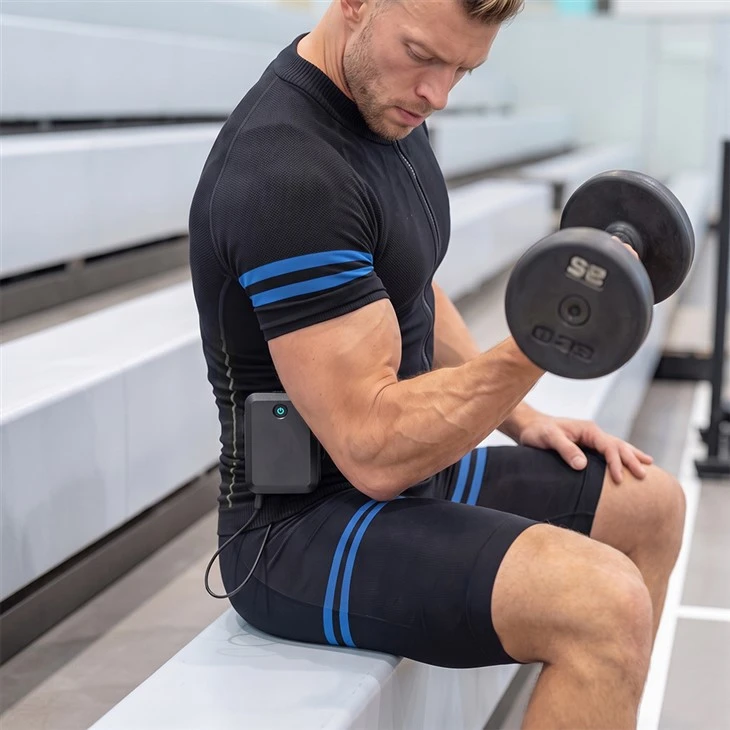
EMS (Electric Muscle Stimulation) training clothing, as a representative of "technology fitness", is rapidly penetrating the home fitness market by reconstructing the value of fitness scenarios and addressing users' deep needs. The underlying logic that drives the market can be broken down into the following six dimensions:
1, Space time compression: redefining fitness efficiency
20 minutes equals 2 hours of traditional training
Scientific basis: High frequency electrical pulses (80-120Hz) forcibly activate type II fast muscle fibers, resulting in a 3.2-fold increase in muscle metabolic equivalent (MET).
User scenario: Attract time scarce groups such as working parents and frequent business travelers, and transform "fragmented fitness" into effective training.
No equipment, small space adaptation
Space Revolution: Only 1 ㎡ activity area is needed to solve the "space anxiety" of home fitness (compared to treadmills occupying 2 ㎡+).
Minimalist equipment: Single piece training clothes replace traditional equipment such as dumbbells and elastic bands, reducing the "start-up cost" of home fitness.
2, Experience Upgrade: Gamified Neurofeedback
Immersive Training System
VR/AR linkage: By using motion capture technology to bind the intensity of electrical stimulation to virtual scenes (such as automatically enhancing lower limb stimulation when avoiding obstacles).
Data visualization: The APP displays real-time muscle activation heat maps, transforming abstract training into "visible progress".
Personalized Coach Algorithm
Dynamic parameter adjustment: Based on user electromyography (EMG) and heart rate variability (HRV), AI automatically optimizes the stimulation plan.
Scenario based course package: Launch specialized programs such as "Office Prolonged Sitting First Aid" and "Postpartum Repair" to accurately match the needs of family users.
3, Scientific endorsement: Medical grade technology for dimensionality reduction
Clinical data empowers trust
Medical research collaboration: Collaborating with sports rehabilitation institutions to release a white paper, proving that the effectiveness rate for sarcopenia and chronic back pain is 25% higher than traditional therapies.
Certification support: By obtaining FDA Class II medical device certification (for muscle rehabilitation scenarios), we aim to enhance our professional image.
Visualization of comparative experiments
User Witness Program: Recruit 1000 testers for 8-week comparative testing, and release third-party testing reports on muscle growth, body fat percentage changes, and other aspects.
4, Community Fission: Creating a "Technology Fitness" Identity Label
UGC Content Ecology
Short Video Challenge: Launch # My 20 Minute Carving Plan # to encourage users to share before and after training comparisons and user experiences.
KOL layered cooperation: Technology bloggers interpret technical principles, fitness experts showcase training effects, and medical KOLs emphasize the value of rehabilitation.
Membership subscription system
Hardware+Content Bundle: Purchase training clothes and receive a 12-month exclusive course library as a gift. Subsequent courses will be subscribed ($19.9/month).
Community benefits: Paid members can participate in online live classes and receive customized exercise prescription services.
5, Price strategy: Penetrating market segmentation
Entry level product line
Basic model: Focusing on core muscle groups (such as abdomen/buttocks) stimulation, priced at $299, with a focus on "trying out technology fitness".
Professional version: Full body 16 channel stimulation+biosensor, priced at $699, targeting fitness enthusiasts and rehabilitation groups.
6, Ecological Loop: From Hardware to Health Data Banking
Health data assetization
API Open Platform: Allow third-party health apps to access user training data, forming a closed loop of "exercise nutrition sleep".
Insurance cooperation: Cooperate with life insurance companies, and users can receive premium discounts (based on health improvement assessments) by providing training data.
Hardware iteration path
Flexible electrode upgrade: New material electrodes (such as graphene silver nanowire composite coatings) are launched annually to improve stimulation accuracy.
Exploration of Brain Computer Interface (BCI): Collaborating with a neuroscience company to develop the "Mind Control Stimulus Intensity" function, enhancing the sense of technology.
Key nodes for market disruption
6 months: Completed market education through KOL marketing and user witnessing, with sales exceeding 100000 units.
12 months: Launch a medical grade rehabilitation product line and establish cooperation channels with physical therapy clinics.
24 months: Build a user health data platform and initiate IPO or strategic financing.
The success of EMS training uniforms is essentially achieved through a triangular model of "neuroscience+consumer grade hardware+data services", which upgrades traditional fitness from "physical labor" to "precise neural regulation" and redefines the value chain of home fitness.