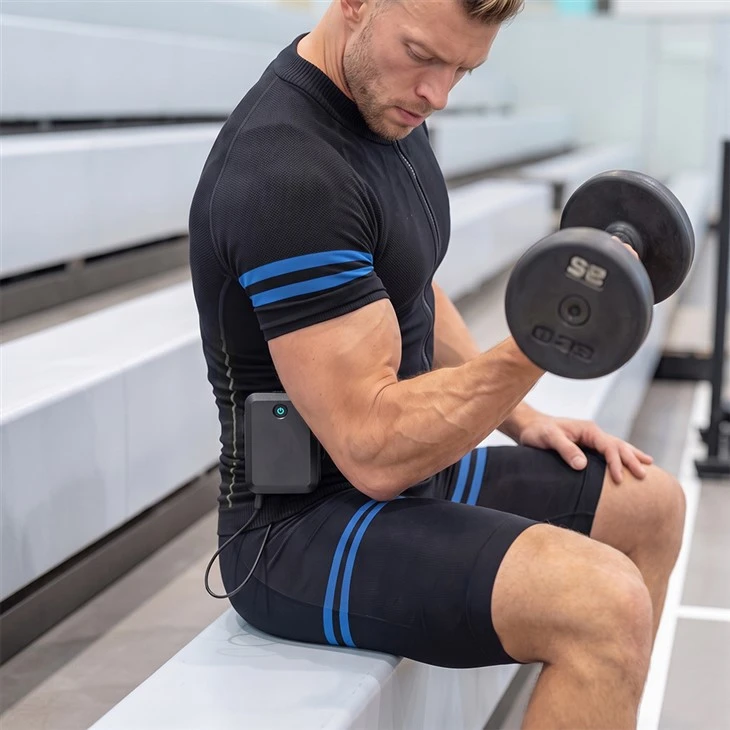
The core muscle groups (waist, back, abdomen, buttocks) are the foundation of body stability, and their strength decline can lead to problems such as lower back pain and imbalanced posture. The EMS training suit uses neuromuscular electrical stimulation (NMES) technology to accurately activate deep muscle groups and help efficiently restore core strength. The following is a phased implementation plan:
1, Principles and advantages
Deep activation
Traditional training, such as abdominal curling, mainly relies on surface muscle groups. EMS directly stimulates deep stabilizing muscles such as transverse abdominis and multifidus through 20-150Hz adjustable pulses, increasing efficiency by 4-6 times.
Neural remodeling
Electrical signals simulate brain commands and promote the regeneration of neuromuscular synaptic connections, especially suitable for postpartum repair and those with sedentary muscle atrophy.
safety threshold
Medical grade equipment is equipped with an upper limit of current intensity (usually ≤ 100mA) to avoid excessive fatigue and is suitable for use during the rehabilitation period.
2, 8-week advanced training plan
🔹 Week 1-2: Neural Awakening Stage
Frequency: 3 times/week, 20 minutes each time
Program selection:
Mode 1: Alternating stimulation of rectus abdominis and erector spinae muscles (50Hz square wave, 20% duty cycle)
Action coordination: Tablet support (EMS enhances core stability)
Intensity: Based on "slight muscle tremors but no pain", gradually increase by 5% intensity per week.
🔹 Week 3-4: Muscle fiber thickening stage
Frequency: 4 times/week, 30 minutes each time
Program selection:
Mode 2: Composite waveform (80Hz triangular wave+20Hz square wave superposition)
Action coordination: Bird dog style (activates gluteal muscles and waist coordination)
Intensity: Increase to feel "significant muscle contraction but tolerable", and adjust with electromyographic feedback.
🔹 Week 5-6: Power Conversion Stage
Frequency: 4 times/week, 40 minutes each time
Program selection:
Mode 3: Dynamic frequency conversion (100Hz pulse+random frequency disturbance)
Action coordination: TRX hanging belly roll (with unstable plane training added)
Intensity: approaching the maximum tolerance value (RPE grade 8-9), triggering the development of type II muscle fibers.
🔹 Week 7-8: Functional Integration Phase
Frequency: 3 times/week, 50 minutes each time
Program selection:
Mode 4: Multi channel collaboration (6-channel linkage of waist, abdomen, and buttocks)
Action coordination: rotating and throwing the medicine ball (simulating dynamic motion chain)
Intensity: Periodic fluctuations (high/medium/low intensity cycles) enhance muscle endurance and explosive power.
3, Effect Enhancement Techniques
Respiratory synergy
During the "current on" phase of stimulation, the abdomen swells during inhalation to reduce discomfort, while during the "current off" phase, the core tightens during exhalation.
Alternating cold and hot compress
Hot compress before training (40 ℃/10 minutes) enhances muscle elasticity, while cold compress after training (15 ℃/5 minutes) reduces delayed onset soreness.
Nutritional window period
Supplement branched chain amino acids (BCAA) and carbohydrates (1:3 ratio) within 30 minutes after training to promote muscle protein synthesis.
4, Risk control
Taboo population: Implantable electronic device users, pregnant women, and patients with acute inflammation should avoid use.
Intensity monitoring: Through the EMG electromyography value of the APP (effective if the target muscle group activation is greater than 60%).
Recovery management: Rest completely at least once a week and maintain a neutral spine position during sleep (using ergonomic pillows).
5, Effect evaluation
Subjective indicators: duration of flat support (increased by 10-15 seconds per week), stability when standing on one leg.
Objective indicators: waist to hip ratio (male<0.95, female<0.85), supine leg lift test (completed within 30 seconds).
Through the EMS training suit, you can achieve a transformation of core strength from "compensatory dependence" to "autonomous control" within 8 weeks, rebuilding the underlying logic of your body's movement chain. It is recommended to consult a sports medicine expert before first use to customize a personalized plan.