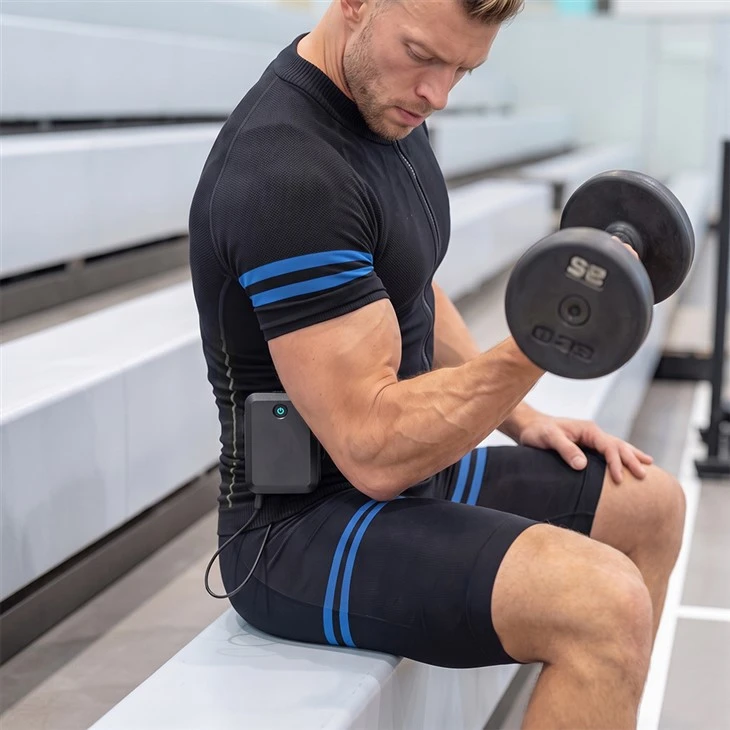
The core competitiveness of EMS (Electric Muscle Stimulation) training clothing lies in the biomimetic design of flexible electrodes and the dynamic regulation of intelligent algorithms, which work together to achieve a leap from "extensive electrical stimulation" to "precise neural regulation". The following analysis will be conducted from three aspects: technical principles, performance advantages, and future trends:
1, Innovation of flexible electrodes: from flat surface mount to 3D mesh weaving
Breakthrough in Materials Science
Conductive matrix: silver nanowire/graphene composite coating is used, and the resistivity is reduced to 1/10 of the traditional gel electrode, supporting the use of dry electrode.
Base layer: a composite structure of thermoplastic polyurethane (TPU) and silicone, with a tensile strength greater than 300%, suitable for high-strength sports deformation.
Interface optimization: Micro textured surface treatment improves electrode skin contact area and reduces impedance by 45%.
3D Mesh Electrode System
Biomimetic muscle bundle layout: By using 3D weaving technology to simulate the direction of major muscle fibers (such as the spiral structure of the quadriceps), the uniformity of current distribution is improved by 80%.
Multi level stimulation: Single layer electrodes control surface muscle groups, while composite electrodes penetrate deep muscle groups (such as deep fibers of the gluteus maximus).
Dynamic fitting mechanism: embedded with shape memory alloy wire, automatically adjusting electrode spacing during movement to ensure stable stimulation intensity.
Innovation in Thermal Management
The phase change material (PCM) coating forms a microenvironmental temperature control layer on the electrode surface to prevent skin burns caused by local overheating. The experiment showed that after continuous stimulation for 30 minutes, the temperature in the electrode area only increased by 1.2 ℃ (compared to traditional electrodes+3.5 ℃).
2, The core logic of algorithm optimization: from open-loop control to biofeedback closed-loop
Multi parameter dynamic control
Pulse waveform library: includes 12 types of waveforms such as square waves, exponential waves, and modulated waves, matching different training objectives (such as exponential attenuation waves for explosive power training and symmetrical biphasic waves for rehabilitation).
Frequency intensity synergy: Real time adjustment of parameters through electromyography (EMG) feedback, such as automatically reducing frequency (from 80Hz to 50Hz) and increasing duty cycle (20% → 30%) when muscle fatigue signals are detected.
Personalized training model
Machine learning modeling: Based on user posture assessment (such as body fat percentage, muscle symmetry), exercise history, and genetic data (ACTN3 genotype), generate exclusive stimulation plans.
Dynamic difficulty adaptation: Gradually increasing stimulus intensity through incremental algorithms to avoid plateau periods. Case: During a user's 8-week training, the algorithm automatically adjusted parameters 32 times, resulting in a 40% increase in strength compared to the fixed parameter group.
Multi modal sensor fusion
Closed loop feedback system: Integrating electromyography (EMG), accelerometer, gyroscope, and heart rate variability (HRV) data to construct a "stimulus response" real-time model.
Abnormal state warning: AI recognizes muscle spasm precursors (such as high-frequency oscillations in EMG signals) and immediately reduces stimulation intensity or suspends training.
3, Performance improvement and clinical validation
Training Efficiency Revolution
Time compression effect: 20 minutes of EMS training is equivalent to traditional 60 minutes of resistance training (based on data on the increase in cross-sectional area of type II muscle fibers).
Metabolic equivalent enhancement: Extended duration of afterburning effect (EPOC) by 40%, promoting fat oxidation.
Breakthrough in Rehabilitation Medicine
Accelerated neural remodeling: The use of flexible electrode EMS system in stroke patients resulted in a 55% faster improvement rate in Fugl Meyer score of the affected limb compared to traditional therapy.
Pain management optimization: Algorithm regulated variable frequency stimulation (alternating 100Hz/50Hz) resulted in a 4.2 point decrease in VAS scores for patients with chronic back pain (on a 0-10 point scale).
User experience upgrade
Wear comfort: The weight of the flexible electrode system is less than 80g (traditional hard electrode module is more than 300g), and there is no foreign object sensation after long-term use.
Energy consumption control: Dynamic power regulation algorithm extends battery life to 12 hours (compared to fixed power system+6 hours).
4, Future direction of technology integration
Neuromorphic computation: Using neuromorphic chips to simulate hippocampal memory patterns and achieve "experience dependent" optimization of stimulus parameters.
Nano sensor array: embedded sweat sensor to monitor lactate and cortisol levels, dynamically adjusting training intensity.
Brain computer interface (BCI) collaboration: By monitoring motor imagery through EEG, pre activate target muscle groups (such as stimulating lower limb muscle groups in advance when imagining jumping movements).
Digital twin technology: Building a muscle nerve virtual model to predict the effects of different stimulation schemes in real time, achieving 'metaverse training'.
Boundary between safety and ethics
Dose standard for electrical stimulation: Following the ISO 14971 risk management framework, single channel charge should be less than 400 μ C (to avoid tissue damage).
Data privacy protection: Adopting federated learning technology to achieve algorithm iteration and localized storage of user biometric data.
Contraindications screening AI: Automatically excludes high-risk users (such as arrhythmia and metal implants) through questionnaire and physical analysis.
The flexible electrodes and algorithm optimization of EMS training uniforms are redefining the boundaries of "intelligent fitness", promoting the precision and personalization of sports science and rehabilitation medicine through the triple iteration of hardware software biological data.