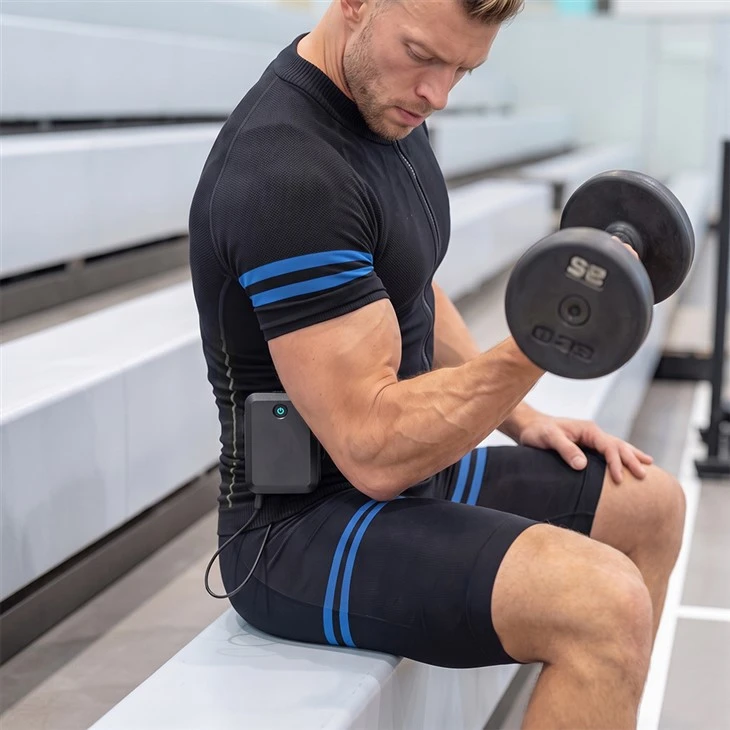
EMS fitness clothing directly stimulates deep muscle groups through electrical pulse technology, and its principle can be broken down into the following scientific path, combining neuromuscular mechanisms with engineering technology innovation:
1. Breaking through the surface muscle barrier: the penetrability of electrical signals
Deep muscle group localization: such as multifidus (spinal stability), transversus abdominis (core tightening), etc., located deep in the trunk, traditional training is difficult to activate due to compensatory movements or insufficient load.
Current conduction path: EMS equipment releases low-frequency pulses (usually 1-50Hz) through conductive materials (such as silver fiber electrode sheets), and the current penetrates the surface muscle group (such as rectus abdominis) along the path of least resistance, directly acting on deep muscle fibers.
2. Neural recruitment mechanism: forced activation of dormant motor units
Classification of exercise units: Muscles are composed of slow muscle (type I, endurance) and fast muscle (type II, strength) fibers, and deep muscle groups are mainly composed of slow muscle. Traditional low-intensity training is difficult to fully recruit.
Electric pulse coverage: EMS synchronously stimulates multiple motor units (especially deep small diameter slow muscle fibers), bypassing the brain's inhibition of "non essential muscle groups" and forcing them to contract.
Comparative experiment: In traditional abdominal rolling training, the activation rate of the transverse abdominal muscle is only 15-20%; Under EMS stimulation, it can reach 60-75%.
3. Biofeedback loop: precise regulation of stimulation parameters
Intelligent algorithm optimization: High end EMS equipment monitors muscle response in real-time through electromyography sensors (EMG), dynamically adjusting pulse frequency, intensity, and waveform.
Parameter setting logic:
Frequency: 20-30Hz promotes endurance of deep muscle groups (such as core stability), 50-80Hz enhances explosive power (combined with active force).
Pulse width: 300-500 μ s to ensure the depth of current penetration and avoid excessive fatigue of surface muscles.
Case application: In response to postpartum rectus abdominis separation, EMS reshapes myofascial tension balance by alternately stimulating the transverse abdominis muscle and the internal and external oblique muscles.
4. Metabolic microenvironment remodeling: promoting deep muscle fiber regeneration
Blood perfusion enhancement: Electrical stimulation triggers vasodilation, increasing deep muscle blood flow by 30-50% and accelerating the clearance of metabolic waste (such as lactate).
Satellite cell activation: The proliferation rate of satellite cells in deep muscle fibers (key for muscle repair) is doubled under electrical stimulation.
5. Practical application suggestions
Electrode placement: For the deep multifidus muscle, the electrodes should be arranged longitudinally along the L1-L5 segments on both sides of the spine; To activate the transverse abdominis muscle, the electrode should be placed at the tendon attachment point of the transverse abdominis muscle (inside the anterior superior iliac spine).
Training cycle: 2-3 times a week, 20 minutes each time, combined with a 10 second stimulation+5-second relaxation cycle.
Contraindications: Avoid use in areas with metal implants, pregnant women and patients with arrhythmia are prohibited from using.
Limitations reminder
Neuroadaptation: Long term passive stimulation may lead to a decrease in active neural recruitment ability, and it is recommended to alternate with traditional training such as Pilates.
Muscle fiber type limitation: EMS has limited thickening effect on fast muscle fibers (IIb type), and maximum strength breakthrough still relies on heavy weight training.
Through the above mechanism, EMS fitness clothing provides a solution for deep muscle group activation that is difficult to achieve with traditional training, especially suitable for rehabilitation, core stability enhancement, and fragmented training scenarios. But its effectiveness needs to be combined with scientific parameter settings and periodic evaluations to avoid excessive dependence.