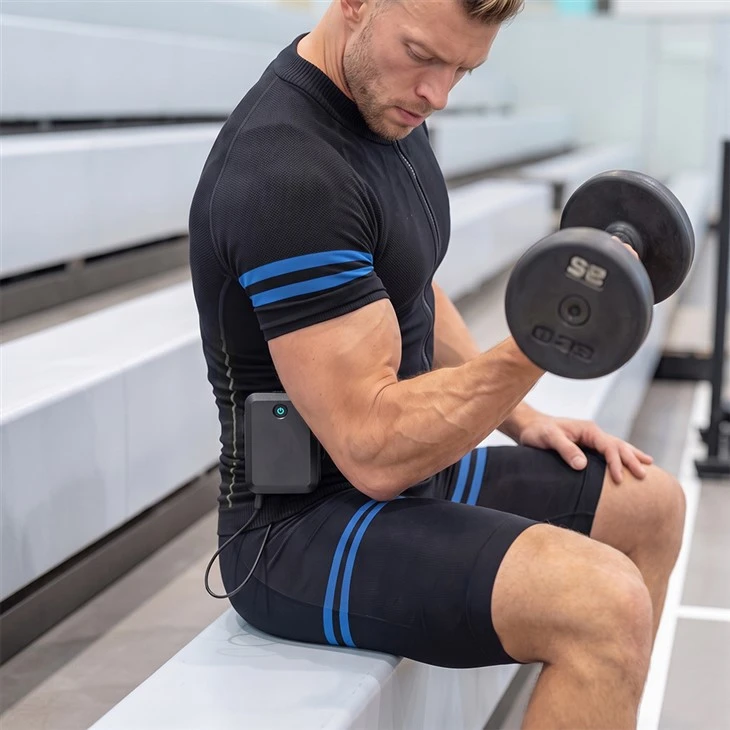
The Future of Intelligent EMS: Integrating Biofeedback and AI-Driven Intensity Modulation
The EMS (Electro Muscle Stimulation) industry is undergoing a paradigm shift from static, timer-based devices to dynamic, adaptive systems. For B2B stakeholders, the integration of Biofeedback mechanisms represents the next frontier in personalization and safety. By utilizing real-time physiological data, modern EMS hardware can now adjust its output to match the user's immediate muscular state.
1. Understanding the Closed-Loop System: How Biofeedback Works
Traditional EMS is an "open-loop" system: the trainer sets an intensity, and the device delivers it regardless of the muscle's fatigue level. In contrast, a Biofeedback-integrated suit utilizes embedded EMG (Electromyography) sensors to monitor the muscle's own electrical activity during the stimulation.
- Real-time Fatigue Monitoring: Sensors detect shifts in the power spectrum of the muscle signal, indicating early-onset fatigue before the user even feels it.
- Automatic Intensity Balancing: If the AI detects that the left quadricep is responding less than the right, it can autonomously recalibrate the mA (milliampere) output to maintain symmetry.
- Neural Adaptation Prevention: By constantly varying the pulse modulation based on feedback, the system prevents the "plateau effect" common in static training.
2. Technical Comparison: Static EMS vs. AI-Adaptive EMS
For professional distributors, moving to AI-driven hardware is a significant USP (Unique Selling Proposition). Our Shenzhen R&D facility is currently prototyping systems that utilize neural networks to optimize "Pulse Recipes" for individual users.
| Technical Feature | Standard Digital EMS | AI-Adaptive Biofeedback EMS |
|---|---|---|
| Control Logic | Fixed / Manual Presets | Dynamic Closed-Loop (PID Controller) |
| Fatigue Prevention | User Observation Required | Automated Pulse Frequency Attenuation |
| Sensor Integration | Electrodes Only (Output) | Electrode + EMG Sensor (Input/Output) |
| Data Analytics | Basic Usage Logs | Deep Muscular Recruitment Insights |
3. Hardware Challenges: Miniaturization of High-Fidelity PCBA
Implementing biofeedback requires sophisticated Analog-to-Digital Converters (ADC) within the energy box to capture the micro-volt signals of the human muscle. As a manufacturer, the challenge lies in noise cancellation-ensuring that the high-voltage stimulation pulses do not overwhelm the sensitive EMG monitoring sensors. This necessitates proprietary shielding and advanced signal processing algorithms within the PCBA (Printed Circuit Board Assembly).
R&D Insight: The next 24 months will see the rise of "Predictive Stimulation," where the AI anticipates muscle failure and shifts the pulse width to a "Recovery Mode" mid-repetition to prevent DOMS (Delayed Onset Muscle Soreness).
4. Smart EMS Technology FAQ
Q: Is AI-integrated EMS safe for beginners?
A: It is actually safer. Because the AI monitors the muscle's response in real-time, it can prevent over-stimulation by automatically capping the intensity if it detects an abnormal contraction pattern or excessive muscular tension.
Q: Can these smart suits be used for competitive athlete monitoring?
A: Absolutely. The data generated by EMG-enabled EMS suits is invaluable for coaches looking to measure the exact motor unit recruitment levels during specific movements, allowing for 100% data-driven training adjustments.