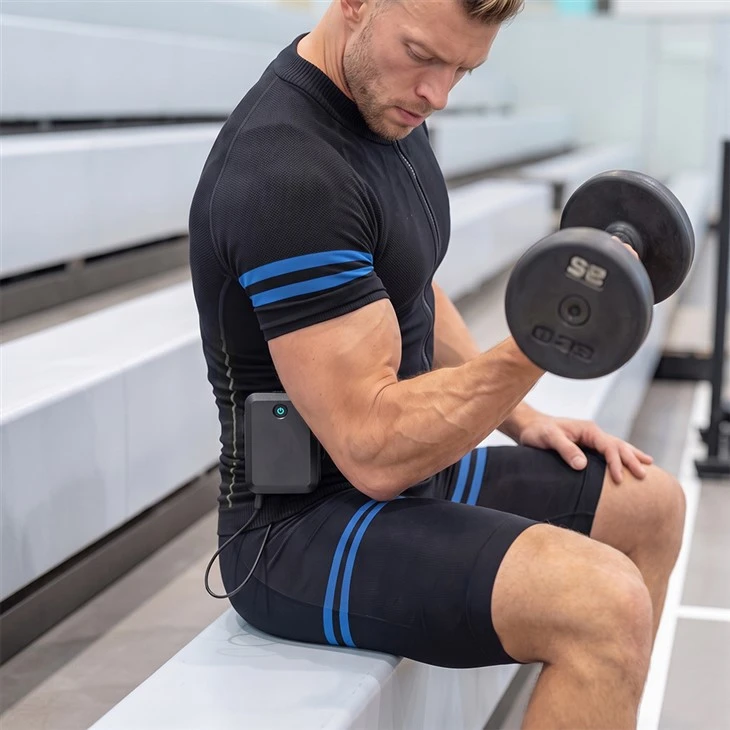
Neuromuscular Recovery in Professional Athletics: Leveraging EMS for Accelerated Metabolic Waste Clearance
In the elite sports and high-intensity fitness sector, the speed of recovery is as critical as the intensity of training. Whole-Body EMS (WB-EMS) has evolved beyond a strength-building tool into a sophisticated recovery modality. By utilizing specific low-frequency pulse profiles, EMS can facilitate Active Recovery-accelerating the removal of metabolic byproducts like blood lactate without placing additional mechanical stress on the joints or central nervous system.
1. The "Muscle Pump" Mechanism: Enhancing Venous Return
Post-exercise muscle soreness (DOMS) and fatigue are often caused by the accumulation of metabolic waste and localized edema. Professional EMS recovery protocols utilize a 1Hz to 10Hz frequency. These low-frequency pulses trigger rhythmic, non-tetanic contractions that act as a "secondary heart."
- Vascular Dilation: The rhythmic contraction-relaxation cycle promotes the release of Nitric Oxide (NO), dilating the capillaries and increasing nutrient-rich blood flow to the damaged muscle fibers.
- Lymphatic Drainage: The pressure changes within the muscle tissue assist the lymphatic system in flushing out inflammatory markers and cellular debris.
- Parasympathetic Activation: Low-frequency stimulation can shift the body from a "fight or flight" (sympathetic) state to a "rest and digest" (parasympathetic) state, lowering systemic cortisol levels.
2. Technical Comparison: Passive Rest vs. EMS Recovery
For professional athletic clubs and studio owners, the data-driven efficiency of EMS recovery is a measurable advantage. Our Shenzhen R&D engineering facility has tested various recovery waveforms to identify the optimal "Pulse Density" for maximum waste clearance.
| Recovery Factor | Passive Rest (Sitting/Sleeping) | WB-EMS Recovery (Active) |
|---|---|---|
| Lactate Clearance Rate | Standard (Baseline) | Accelerated by ~30-50% |
| Joint Load | Zero | Zero (No mechanical impact) |
| Muscle Oxygenation | Limited to baseline respiration | Significantly increased via micro-circulation |
| CNS Fatigue | Recovery phase | Non-taxing; promotes relaxation |
3. Algorithm Specifics: Why 1-10Hz is the "Sweet Spot"
When an EMS suit delivers a frequency above 35Hz, the muscle enters a state of fused contraction (tetany), which consumes energy and generates fatigue. For recovery, the hardware must deliver a Monophasic or Biphasic Pulse at a low enough frequency that the muscle has time to fully relax between each "twitch." This intermittent pumping action is what optimizes the vascular-lymphatic flow without depleting glycogen stores.
Expert Insight: For optimal post-competition recovery, use a "descending intensity" protocol. Start at 10Hz for 5 minutes to clear blood lactate, then drop to 1-4Hz for 15 minutes to facilitate deep lymphatic drainage.
4. EMS Neuromuscular Recovery FAQ
Q: Can EMS recovery prevent Delayed Onset Muscle Soreness (DOMS)?
A: While it cannot "eliminate" DOMS (which is caused by micro-tears in the muscle), EMS significantly reduces the perception of pain and the duration of stiffness by preventing the stagnation of inflammatory fluids around the muscle fibers.
Q: Is it safe to use recovery mode every day?
A: Yes. Because the recovery frequency (1-10Hz) does not place stress on the central nervous system or joint structures, it can be used daily as part of a wind-down or maintenance routine, especially for professionals with high training volumes.