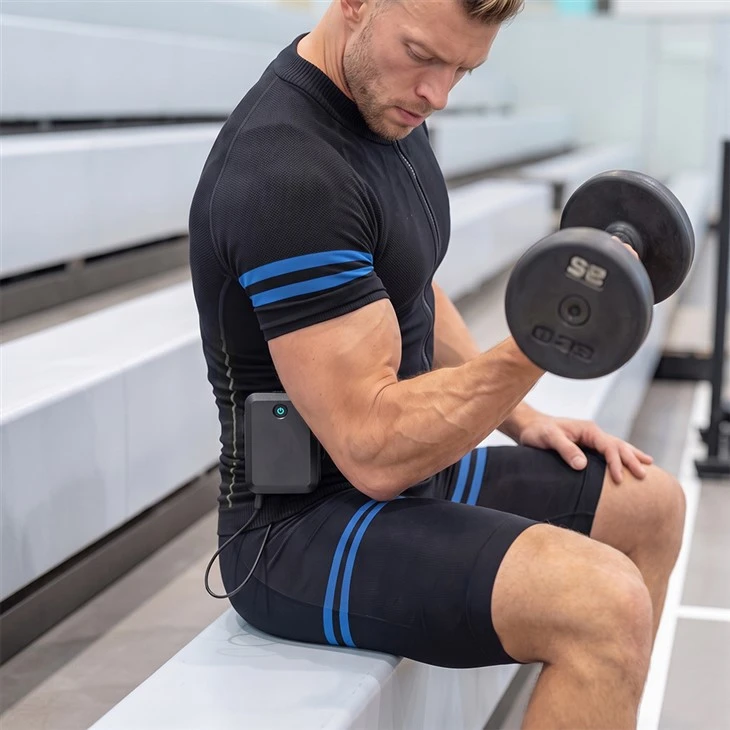
Correcting Muscle Imbalances with EMS: The Role of Independent Multi-Channel Intensity Modulation
Muscle asymmetry is a common pathology among both elite athletes and sedentary office workers, often leading to chronic joint pain and reduced athletic performance. In traditional resistance training, the dominant side often compensates for the weaker side, reinforcing the imbalance. Whole-Body EMS (WB-EMS) provides a technical solution by allowing for asymmetrical intensity loading across 20+ independent muscle groups.
1. The Failure of Bilateral Movements in Symmetry Correction
When performing a standard barbell squat or bench press, the central nervous system (CNS) prioritizes the completion of the movement over perfect symmetry. This results in the stronger limb performing a higher percentage of the work. For B2B fitness providers, integrating EMS allows for a unilateral override, where the weaker side can be stimulated at a higher milliampere (mA) level than the stronger side during the same movement.
- Neural Re-education: EMS forces the weaker motor units to fire, "reminding" the brain how to recruit those specific fibers.
- Isolated Hypertrophy: By increasing the pulse width on only one side of the body, trainers can drive localized muscle growth to match the opposing side.
- Posture Realignment: Correcting imbalances in the erector spinae or gluteal groups can resolve functional scoliosis and pelvic tilts.
2. Technical Comparison: Standard Training vs. EMS Symmetry Protocols
For professional studios, the ability to measure and correct asymmetry is a major value proposition. Our Shenzhen-engineered control systems allow for real-time adjustments of 24 independent channels, providing a granular level of control that is impossible with traditional weights.
| Imbalance Type | Traditional Solution | WB-EMS Technical Solution |
|---|---|---|
| Left-Right Limb Asymmetry | Dumbbell work (High time cost) | Asymmetrical mA intensity settings |
| Anterior-Posterior Tilt | Static stretching/Specific lifts | Opposing muscle group pulse modulation |
| Core Instability | Planks/Stability balls | Isolated TVA and Multifidus activation |
| Post-Injury Atrophy | Physical therapy movements | Passive stimulation of atrophied fibers |
3. The Role of Proprioception in Long-term Realignment
EMS does not just "work" the muscle; it enhances proprioceptive awareness. By sending a concentrated electrical signal to a neglected muscle (such as the gluteus medius), the client develops a better "mind-muscle connection." This neurological feedback loop ensures that the symmetry achieved during the EMS session carries over into their daily movement patterns.
R&D Insight: For rehabilitation-focused EMS suits, we prioritize "Active-Passice Hybrid" software. This allows the suit to maintain a low-level baseline pulse to keep muscles "awake" between high-intensity intervals.
4. EMS Muscle Imbalance Correction FAQ
Q: Can EMS fix pelvic tilt issues?
A: Yes. By balancing the tension between the abdominals, glutes, and lower back extensors, EMS can help pull the pelvis back into a neutral position. This requires a trainer who understands how to modulate the intensity of the front vs. back channels.
Q: Is it safe to use different intensities on each leg?
A: Absolutely. This is the core advantage of professional EMS hardware. As long as the waveform remains Biphasic and Symmetrical, there is no risk in using 30mA on the left leg and 45mA on the right to compensate for atrophy.